
Gen Z Stare Meaning, Origin, and Debate

Social posts, reported creator examples, and independent expert coverage show how an ambiguous pause became a participatory argument about customer service, small talk, and generational stereotypes.
A customer approaches a counter and asks a routine question. The worker looks back without speaking. In the next video, the roles reverse: the worker asks for information, and the customer answers with the same blank expression. Both clips call the silence the “Gen Z stare,” but they disagree about who is doing it and what it means.
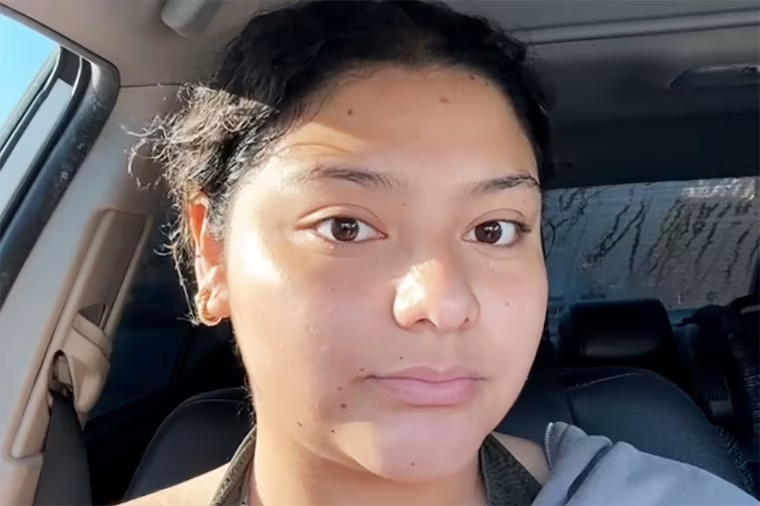
The Gen Z Stare is an internet label for a blank, deadpan, or silent look given when a greeting or answer would normally be expected. It became broadly visible in 2025 through customer-service complaints, rebuttal skits, and debates over whether the pause means confusion, judgment, processing time, or refusal to perform conversational warmth.
What the Gen Z Stare means
The phrase usually describes a vacant expression, silence, or delayed reply during an interaction. Customer-service counters, restaurants, classrooms, workplaces, and casual conversations are common settings.
The face alone has no fixed meaning. Participants use it to represent several reactions:
- confusion about a request;
- disbelief at a question that seems obvious or unreasonable;
- a moment of processing before answering;
- boredom or disengagement;
- judgment without a spoken reply;
- restraint when the speaker does not want to argue;
- unwillingness to perform scripted friendliness.
That ambiguity drives the meme. The person who receives the stare may interpret rejection or poor service. The person giving it may describe overload, confusion, or a deliberate response to a difficult customer.
The earliest documented precursor is from 2024
Know Your Meme identifies a TikTok by @meghan.alessi, posted July 29, 2024, as the earliest example it found. ABC News Australia cites the same finding.
The original post was not directly retrievable during this review. “Earliest documented precursor” is more accurate than “first use,” “invented by,” or “coined by.” Earlier examples may exist.
The label became much more visible in June and July 2025. Complaints about silent customer-service interactions were followed by anecdotes, rebuttals, and two-role skits. A directly indexed example from @dantejamees is dated July 11, 2025, during the viral wave rather than at its origin.
How the format works
The meme is a skit and argument format rather than one fixed image.
- Complaint: A creator describes a greeting or request that received only a stare.
- Two-role skit: One person acts as both customer and worker. A cut to the silent face supplies the punch line.
- Rebuttal: A young worker frames the look as disbelief at an absurd or rude request.
- Definition dispute: Critics say that intentional customer-service judgment is different from ignoring a normal greeting.
- Reaction shorthand: A close-up and pause stand for “I have no useful response to that.”
- Counter-label: Users redirect the joke toward other groups through phrases such as “lead-paint stare,” “blue-light stare,” or the separate “millennial pause.”
The debate became part of the content. Users did not only copy an expression; they argued over which interaction counted, who started the awkwardness, and whether workers owe customers visible warmth.
Customer-service stare and customer stare are not identical
NPR separated two common versions. The “customer-service stare” describes a young worker silently reacting to a customer. The “customer stare” reverses the roles: a customer fails to answer a worker’s question.
Some Gen Z creators also distinguish a deliberate stare at a foolish request from the broader label critics use for unprompted silence. Those definitions conflict, so no one motive applies to every example.
The same expression can function differently when the preceding line changes. Captions and dialogue often matter more than the face itself.
The evidence does not support a diagnosis of a generation
The meme is built from anecdotes, interpretations, and staged skits. It does not show that an entire generation has a communication deficit.
ABC News Australia reported that no definitive scientific evidence links lockdowns to impaired Gen Z social skills. Vox found no peer-reviewed research establishing the stare’s origin, intent, or uniqueness to Gen Z. Experts interviewed by NPR, NBC News, and Vox also noted that young people in earlier generations gave adults blank or disengaged looks.
Pandemic isolation, anxiety, fatigue, online communication, fear of appearing “cringe,” and a preference for authenticity appear in coverage as possible explanations. None has been established as the single cause.
Another reading focuses on interaction scripts. Older customers may expect an immediate greeting, verbal acknowledgment, and practiced warmth. Younger workers may value directness, need time to process, or reject the emotional performance expected in service work. The meme turns that mismatch into a face viewers can interpret in different ways.
Why the argument spread
A silent close-up is easy to reproduce, but the disagreement gives it staying power. One clip can accuse workers of being rude. The next can accuse customers of asking impossible questions. A third can argue that generational labels are the real joke.
The format also connects with older generation-versus-generation memes. “OK Boomer,” “millennial pause,” “lead-paint stare,” and “blue-light stare” all reduce a disputed behavior to a named cohort. The label makes a social irritation searchable while encouraging people to treat individual anecdotes as evidence about millions of strangers.
For more sourced histories of internet formats, browse MemeMeet’s Meme Culture archive.
No verified live MemeMeet product matches this meme, so this article includes no sales link. The merchandise rights gate remains UNKNOWN: the credited frame depicts an identifiable person and has no verified open license or merchandise permission. It appears here only as an attributed editorial reference and does not imply endorsement by the creator or the person shown.
Timeline
| Date | Event |
|---|---|
| July 29, 2024 | @meghan.alessi posts the earliest documented precursor identified by Know Your Meme. |
| June 18, 2025 | Coverage of the “Gen Z gaze” marks the label’s growing visibility. |
| July 11, 2025 | @dantejamees posts a directly indexed participant example during the viral wave. |
| July 14–19, 2025 | The New York Times, USA Today, ABC News Australia, NBC News, NPR, and Vox publish reporting and expert commentary about the trend. |
Frequently asked questions
What is the Gen Z Stare?
It is an internet label for a blank or silent look in a moment when another person expects a greeting or answer. Customer-service skits are its most common setting.
What does the Gen Z Stare mean?
There is no single meaning. Creators describe confusion, processing, boredom, disbelief, judgment, restraint, or resistance to scripted friendliness. The preceding interaction determines the joke.
Where did the Gen Z Stare start?
The earliest documented precursor found by Know Your Meme is a July 29, 2024 TikTok from @meghan.alessi. Because the original post was unavailable during this review, it should not be called the undisputed first use.
Is the Gen Z Stare unique to Gen Z?
No research reviewed for this article establishes that it is unique to Gen Z. Experts noted that deadpan or disengaged responses from young people existed before the current label.
Did pandemic lockdowns cause the Gen Z Stare?
That is an unproven theory. ABC News Australia reported no definitive scientific evidence that lockdowns caused impaired social skills, although several experts said pandemic isolation and online communication could be contributing factors.
Sources
- “Understanding the Gen Z Stare Phenomenon,” @dantejamees/TikTok, July 11, 2025
- “Gen Z Stare,” Know Your Meme
- “Is the Gen Z stare just a call to look inward?,” NPR, July 18, 2025
- “Gen Z is staring at you. It may be more than just a quirk,” NBC News, July 18, 2025
- “Yes, Gen Z Is Staring at You. The Question Is Why.,” The New York Times, July 14, 2025
- “Gen Z’s blank stare is the internet’s latest obsession,” USA Today, July 16, 2025
- “What is the Gen Z stare and what are young people trying to tell us?,” ABC News Australia, July 16, 2025
- “The real reason everyone’s so mad over the Gen Z stare,” Vox, July 2025