
What Is the Loss Meme? | || || |_ Explained

Learn where the Loss meme came from, what | || || |_ represents, why the 2008 Ctrl+Alt+Del strip became a template, and how to recognize it.
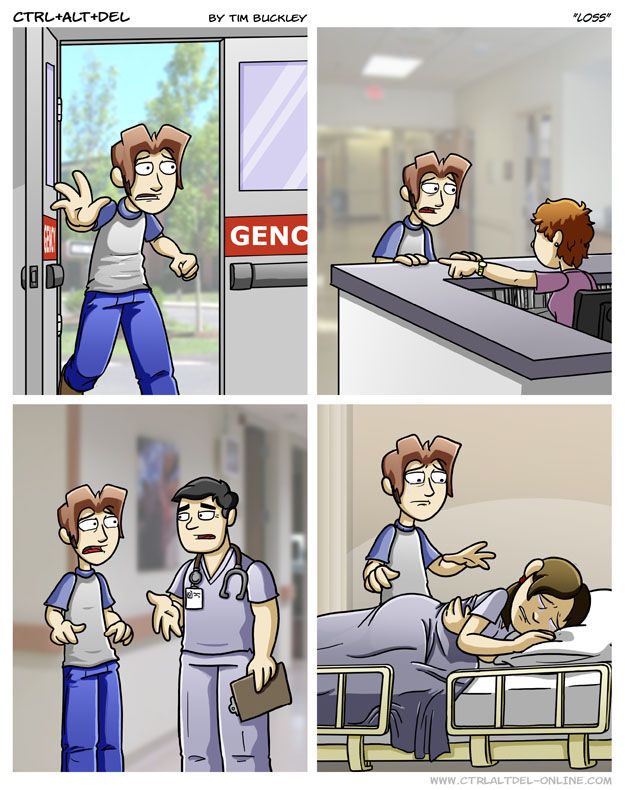
| || || |_ meme. Image: Tim Buckley. View the creator’s source page.The Loss meme turns the four-panel arrangement of Tim Buckley’s 2008 Ctrl+Alt+Del strip “Loss” into a hidden visual pattern, often reduced to | || || |_.
A single line. Two figures. Two more figures. Then one figure standing beside another lying down.
That arrangement is enough for people who know the Loss meme. The drawing can be hidden in furniture, road markings, game pieces, food, or four blocks of text. Someone spots the pattern and asks, “Is this Loss?”
The reference leads back to a silent Ctrl+Alt+Del strip published by Tim Buckley on June 2, 2008. The original comic is not a joke. It shows Ethan rushing through a hospital before finding his fiancée, Lilah, in bed after an implied miscarriage. The meme came from the internet’s reaction to that abrupt change in tone, then survived because the scene could be compressed into a visual code.
Where the Loss meme came from
Ctrl+Alt+Del began as a gaming webcomic. Its regular cast spent much of its early run talking about games, technology, and everyday mishaps. “Loss” interrupted that rhythm with four panels, no dialogue, and a serious pregnancy-loss storyline.
Buckley’s current archive identifies the strip as “Loss” and dates it June 2, 2008.[1] An archived post published beside it shows that the story was deliberate rather than an accidental break from the series. Buckley wrote about planning the storyline and drawing on a pregnancy and miscarriage from his own past.[2] In a 2015 interview with New York magazine, he said he knew the strip would create a strong reaction, though he did not anticipate the form that reaction would take.[3]
The sequence is simple:
- Ethan enters a hospital alone.
- He speaks to a receptionist who points him onward.
- He stands beside a doctor.
- He finds Lilah crying in a hospital bed.
Those positions became the template.
Why “Loss” became a meme
The first layer was criticism. Readers knew Ctrl+Alt+Del as a gaming comedy, so the sudden turn toward reproductive trauma felt jarring to many of them. Contemporary parodies appeared across other webcomics and forum communities. Know Your Meme’s archive documents early responses from titles including Hijinks Ensue and Cyanide & Happiness, while New York traced the spread through 4chan’s video-game board, Something Awful, and Tumblr.[3][4]
The second layer was abstraction. People stopped redrawing the hospital scene and preserved only the placement of its figures. New York described the reduced pattern panel by panel:[3]
- one upright line;
- two upright lines, with the second lower or shorter;
- two upright lines;
- one upright line beside one horizontal line.
Typed as characters, it is often rendered as | || || |_. The exact spacing changes, but the four-part sequence stays recognizable.
This turned a parody of one comic into a pattern-recognition game. A remix no longer needed Ethan, Lilah, a hospital, or even human figures. If four groups of objects matched the layout, the reference worked.
What “Is this Loss?” means
“Is this Loss?” is both a real decoding question and part of the joke. People ask it when an image might reproduce the four-panel arrangement, whether the similarity was intentional or accidental.
The phrase also points to how far the meme moved from its source. Someone can recognize | || || |_ without remembering the names Ethan or Lilah. The layout became a piece of shared visual shorthand, and recognizing a disguised version signals familiarity with older internet culture.
How the format changed
Early versions redrew the characters or replaced them with characters from other comics and media. Later versions used lines, dots, objects, typography, and spatial arrangements. Know Your Meme records the related “Is This Loss?” format as its own branch, while Gizmodo noted a renewed wave of recognition around 2017.[4][5]
Buckley acknowledged the meme in 2018, on the strip’s tenth anniversary, by temporarily changing the archived page to a variation called “Found.” Gizmodo reported that the original returned a day later.[5] That brief alteration showed the creator responding to a remix culture that had long since escaped the original page.
The meme keeps working because creators can hide it at different levels of difficulty. A direct redraw is obvious. Four carefully placed objects may only register after someone comments. The best-known versions make viewers switch from reading the image normally to checking its geometry.
The serious context behind the joke
The original strip depicts miscarriage. That context matters even when a remix uses seven lines and no characters.
Buckley told New York that his response to the parodies changed over time. He described anger and frustration, but also said that he sometimes found individual versions amusing. He also recalled readers who said the storyline resonated with their own experiences of miscarriage.[3]
Those reactions can coexist. Loss remixes are part of internet history, but the source material concerns pregnancy loss. Explaining the meme accurately means naming both the playful visual code and the subject it abstracts.
Why the Loss meme lasted
Most image macros depend on a face and a caption. Loss can survive without either. Its identity sits in relationships between shapes: alone, paired, paired, then standing and horizontal.
That makes the template unusually portable. It can be rebuilt with almost anything, and each new version asks the audience to solve the same small puzzle. The result is less a fixed image than a recognition test passed from one online community to another.
For more documented internet-culture histories, browse MemeMeet’s Meme Culture journal. MemeMeet’s broader work on turning internet-native ideas into physical objects is explained on mememeet.app; this article does not claim that Loss merchandise is licensed or available.
Timeline
| Date | Event |
|---|---|
| June 2, 2008 | Tim Buckley publishes “Loss” in Ctrl+Alt+Del and posts a contemporaneous explanation of the storyline. |
| June 2008 onward | Webcomics and forum communities begin parodying the strip. |
| By the mid-2010s | Abstract and minimalist versions circulate widely; the layout can be reduced to | || || |_. |
| 2015 | New York interviews Buckley and documents the meme’s spread and his changing response to it. |
| Around 2017 | Reporting notes renewed circulation of the minimalist format and “Is this Loss?” recognition joke. |
| June 2–3, 2018 | The original archive briefly displays Buckley’s “Found” variation before “Loss” returns. |
| 2026 | Know Your Meme publishes a new video explainer, showing that the format remains legible across internet generations. |
FAQ
What does | || || |_ mean?
It is a minimalist rendering of the four-panel character arrangement in Tim Buckley’s 2008 Ctrl+Alt+Del strip “Loss.” The final horizontal line represents Lilah lying in a hospital bed.
Why do people ask “Is this Loss?”
They are checking whether an image hides the same four-part layout as the original comic. The question can be sincere, but it is also a recurring joke attached to increasingly abstract versions of the pattern.
Who created the Loss comic?
Tim Buckley wrote and drew “Loss” for his webcomic Ctrl+Alt+Del. His archive dates it June 2, 2008.
Why was the original comic controversial?
It shifted suddenly from a webcomic known for gaming humor to a silent scene about miscarriage. Some readers found the change moving; others criticized its execution and turned its layout into parody.
Is Loss merchandise available from MemeMeet?
No verified Loss product is referenced in this article. The original comic and its recognizable arrangement are associated with Tim Buckley’s copyrighted work, so any commercial design would require a separate rights review.
Sources
- Tim Buckley, “Loss,” Ctrl+Alt+Del, June 2, 2008
- Tim Buckley, “So, then… let’s chat,” archived creator post, June 2, 2008
- Brian Feldman, “Talking to the Man Behind ‘Loss,’” New York, November 2015
- “Loss,” Know Your Meme, accessed September 18, 2026
- Julie Muncy, “One of the ’Net’s Longest-Running Webcomics Has Done Something Weird…,” Gizmodo/io9, June 2–3, 2018
- “The Classic Loss Meme Explained,” Know Your Meme, 2026